
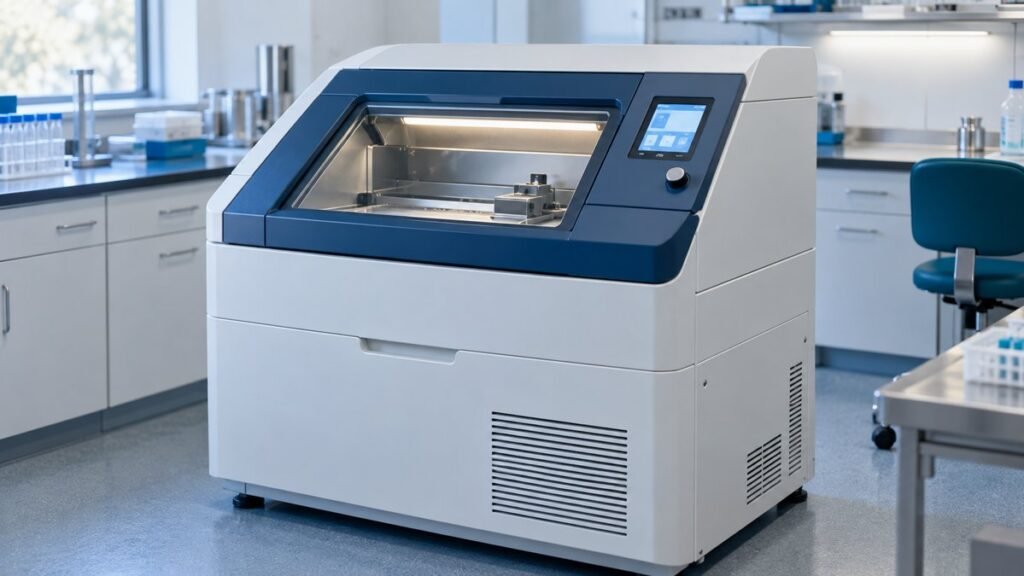
Cryostat temperature instability requires a clear record of the affected temperature display, timing and operating context; a structured observation log supports technical assessment without treating every fluctuation as proof of refrigeration failure
Our cryostat service preparation guide focuses on observable information; the applicable manufacturer instructions and laboratory procedure govern device operation, specimen protection and escalation
Which cryostat temperature is affected?
A cryostat temperature record identifies the specific temperature channel involved; cryochamber and specimen-related readings represent different parts of the device on models with separate temperature controls
The manufacturer descriptions for the Leica CM3050 S and Leica CM1950 illustrate model-specific temperature-control arrangements; those features do not describe every cryostat
The recommended cryostat temperature log fields are:
- Device manufacturer, model and serial number
- Temperature channel or display label
- Selected setpoint and displayed reading
- Observation time and duration
- Alarm message or error code
- Relevant device operating mode
When does cryostat temperature instability occur?
The timing of cryostat temperature instability helps define the investigation; a fluctuation recorded during startup, routine operation or a programmed cycle presents different operating context
Cryostat observation notes separate direct observations from suspected causes; record a recent room change or power interruption as an event rather than declaring the event responsible for the temperature behavior
Does section quality identify a cryostat temperature fault?
Cryostat section quality alone does not isolate a temperature-system fault; sectioning depends on the specimen and device setup as well as temperature conditions
The Leica cryosectioning overview discusses specimen preparation and cryostat workflow; service requests benefit from keeping the observed section defect separate from the reported temperature behavior
The recommended cryostat sectioning observations are:
- Description of the observed section problem
- Temperature readings recorded at the same time
- Relevant setup changes already documented
- Previous service reference, when available
What belongs in a cryostat service handover?
A cryostat service handover connects the temperature log with equipment details and relevant history; the laboratory also communicates access arrangements and any applicable cleaning or decontamination requirements before a technical visit
Cryostat photographs or display screenshots exclude patient identifiers; approved equipment observations provide technical context without disclosing clinical records
Use our histology equipment maintenance records checklist to connect the observation log with earlier service entries; our cryostat service page provides the equipment-specific inquiry route
Cryostat temperature instability FAQs
Does a cryostat alarm confirm the failed component?
A cryostat alarm identifies a reported condition rather than proving a specific failed component; the alarm text, model and operating context guide further assessment
Does every cryostat use the same temperature setting?
Cryostat temperature settings depend on the model, specimen and approved procedure; a universal setpoint is unsuitable for a general service-preparation article
Discuss cryostat support with Nexus
Our histology equipment services include a route to discuss cryostat support; share the model, location and observation log through our contact page
Use the broader medical equipment failure report checklist to keep the cryostat observations, timing and service history together in the repair request.
Need help with this equipment? Nexus Biomedical Services provides cryostat repair and temperature verification for hospitals and labs in New Jersey, Pennsylvania, New York, Delaware and Texas. Request service or call (848) 405-6968.