
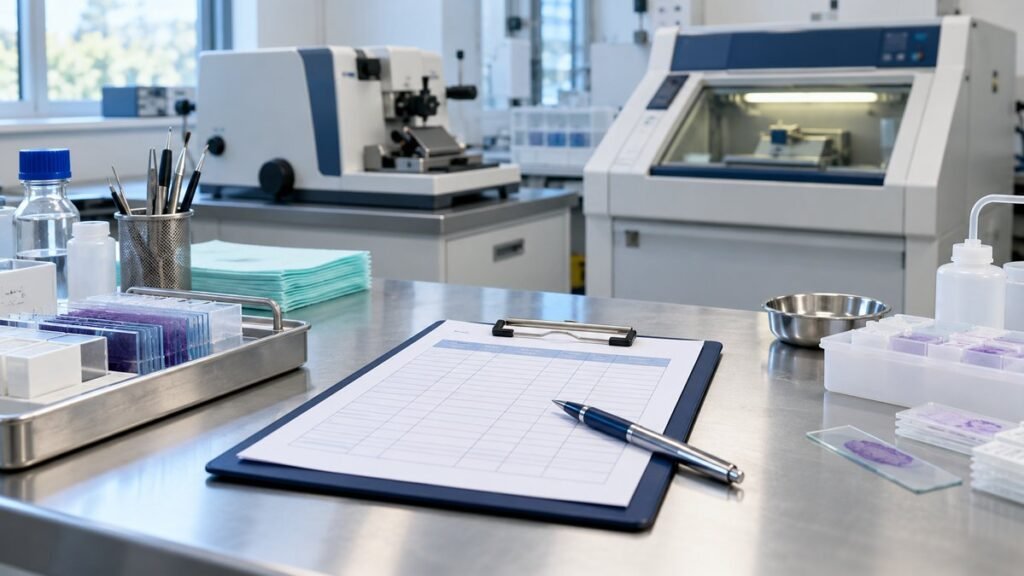
When a tissue processor cycle stops, record the interruption time, exact alarm message, protocol and step, retort or station, reagent information, affected batch reference and actions already taken. Preserve the original run report and event log when available, then follow the instrument instructions and your laboratory incident procedure.
Our checklist helps histology teams organize a service request without confusing an observation with a confirmed equipment fault. Decisions about specimen handling, recovery and diagnostic suitability belong to the responsible laboratory personnel using the applicable manufacturer instructions.
Start with a clear incident timeline
Record the time the cycle started, when the alarm occurred and when staff discovered the interruption. Include the time zone and note any difference between the processor clock and the laboratory clock. Mark estimated times as estimates.
Keep the sequence factual: what the display showed, what the operator observed and what happened next. An alarm after a power interruption does not, by itself, identify the failed component.
Tissue processor interruption record checklist
Use these fields to prepare an equipment incident record and support handover:
- Equipment: manufacturer, model, serial number, asset ID, location and software version if displayed.
- Run identity: batch reference, protocol name, start time, intended finish time and operator identifier.
- Interruption: exact alarm text and code, first occurrence, repeat occurrences and the time each was observed.
- Cycle position: displayed step number, stage, retort or station, and whether the display showed filling, processing, draining or a pause.
- Displayed conditions: reagent identity and station number, temperature and pressure or vacuum readings where available. Distinguish a setpoint from a measured value.
- Batch traceability: basket and cassette count, affected internal batch references and any uncertainty about the load.
- Context: observed power loss, recent reagent change, cleaning, maintenance or an earlier similar incident.
- Response: each action, time, person responsible, support reference and instructions received.
Keep patient identifiers within approved laboratory records. Remove identifying information from screenshots and attachments before sharing an equipment support request outside the authorized clinical workflow.
Preserve the run report and alarm evidence
Save the original report or event-log export using the permitted operator workflow. Capture the complete message and surrounding timestamps rather than typing only a shortened description. Record the filename and attach the relevant evidence to the incident record.
The Leica HistoCore PELORIS 3 manual identifies on-screen warnings, the event log, reagent history, selected protocol and affected specimens as useful troubleshooting information. These are model-specific examples; another processor may use different reports and terminology.
Document reagent and protocol context
Record the selected protocol rather than assuming the usual overnight cycle ran. Include recent reagent replacements and the station information available on the instrument. Do not change settings simply to recreate the incident.
Tissue processing involves dehydration, clearing and wax infiltration after fixation. Leica explains that processing requirements vary with tissue characteristics, processor and reagents. A record of the interrupted stage provides context for laboratory review; it does not establish that the tissue is suitable for further processing.
Keep recovery decisions separate from equipment observations
There is no universal restart instruction for an interrupted tissue-processing cycle. Use the current instructions for the installed model and the laboratory-approved escalation process. Record who authorized the next action and the relevant instruction or procedure reference.
Do not use this checklist as a repair or specimen-recovery procedure. For example, the PELORIS 3 manual warns against opening a running retort and against running a cleaning protocol with tissue present. Access, restart and cleaning requirements must come from the applicable instrument documentation.
Prepare a useful service handover
Send a concise timeline, equipment identifiers, alarm evidence and the actions already taken. State what remains unknown and identify the laboratory contact who can provide access and clarify the incident.
Discuss the equipment and service requirements through our tissue processor service page or contact Nexus Biomedical Services. For ongoing documentation, use our histology equipment maintenance records checklist.
Close the record after review
Add the service findings, corrective actions, any required checks and the person authorizing return to use. Record the laboratory decision about the affected batch separately, with a reference between the two records. A completed equipment repair does not automatically resolve specimen-quality questions.
For a consistent handover beyond the stopped run, use our medical equipment failure documentation guide to organize the device details, observed fault and service history.
Need help with this equipment? Nexus Biomedical Services provides tissue processor repair for hospitals and labs in New Jersey, Pennsylvania, New York, Delaware and Texas. Request service or call (848) 405-6968.